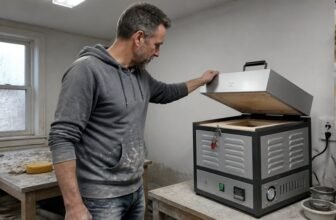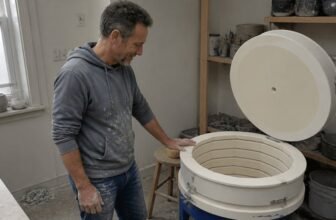
Kiln error codes can feel like a secret language, but they really just tell two basic stories about your firing: the heat is rising too slowly, or the power has been cut. If you are staring at a flashing Err 1, FTL, or PF on your controller right now, you are likely mid-batch and wondering whether to unload or troubleshoot. This article explains what each of those codes means, starting with Err 1 as a slow heat warning, then moving through the dramatic FTL, and ending with power loss signals like PF and ErrP. I have dealt with my own share of mystifying error messages, so I will keep the explanations plain and practical.
You will learn how to read the symptoms, what to check before you replace any parts, and why a voltage test can save you money.
By the end, you will know whether your kiln needs a new part or just a clean restart, and that clarity makes all the difference for your next glaze load. Let us start with the most common culprit: Err 1 and what it says about your heating pace.

Restores even heat and prevents slow firing errors.

Accurate temperature readings stop false Err 1 alerts.
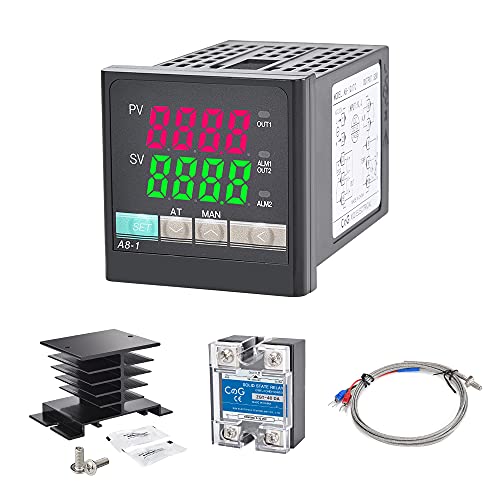
Replaces stuck contactors to avoid FTL overruns.
Check discounted items inKiln Parts & Accessories
Quick Answer
- Err 1 means slow heating under 12°F per hour for over 22 minutes, often from worn elements.
- FTL signals a firing that ran two hours over schedule, needing a hard stop and relay replacement.
- PF indicates a full power outage with over 250°F drop, so reload the kiln manually.
- ErrP is a brief power blip; press “1” to resume without repairs.
- Diagnose slow heating with voltage, amp clamp, and element glow tests before replacing parts.
Err 1 and FTL: Why Your Kiln Heats Too Slowly
Err 1 and FTL are two temperature warnings that both point to slow heating, but they measure different problems. Err 1 appears when the kiln climbs less than 12°F per hour for over 22 minutes. FTL means the firing ran two hours longer than expected, a timeline no potter signed up for.
Element wear tops the suspect list; old coils just lose their sizzle. Thermocouple drift can fool the controller into reading cooler than reality, which also slows the climb. A voltage drop test reveals weak supply, like 208 volts when you need 240. Relay diagnostics catch stuck or chattering contactors, the kiln’s grumpy gatekeepers.
Start with the Full Power Test and look for dull elements or cold sections. Measure, don’t guess.
Replace worn parts, verify amps per section, and let the kiln breathe easy again.
PF vs. ErrP: What Happens When Power Drops Mid-Fire?
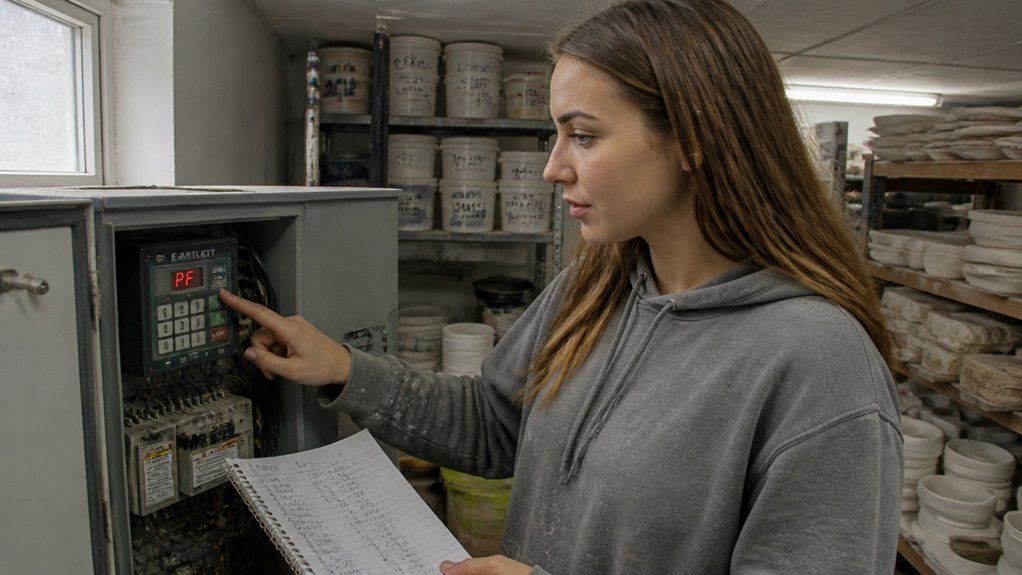
A power outage mid-fire leaves a telltale error code. PF means the firing stopped cold, usually when temperatures drop over 250°F or fall below 1400°F. That is a hard stop, no sugarcoating.
ErrP is the controller’s shrug. A brief blip, power returned, and the firing carried on. Think of it as the kiln catching its breath.
Both codes come from a power outage, but the recovery modes differ sharply. PF often needs manual clearing and inspection. ErrP just asks you to press “1” and move on.
If your kiln shows ErrP, finish the firing and check the ware. With PF, plan on reloading the kiln. ErrP is a hiccup. PF is a headache.
Do not gamble on either. Verify your elements before blaming the grid.
How to Test Voltage, Amps, and Element Glow Before Replacing Parts
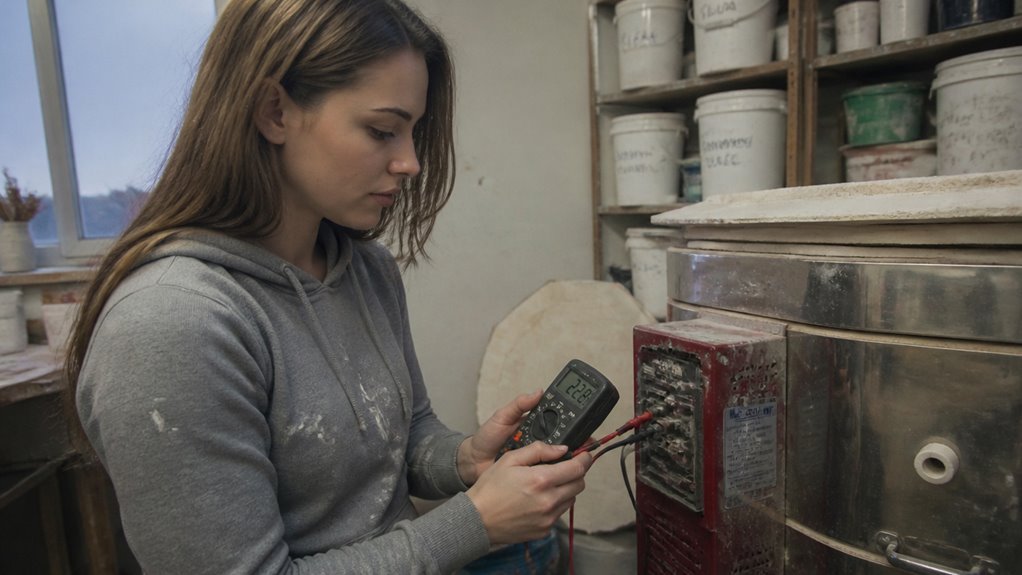
Run these three tests before you replace any element or relay. They tell you what is actually broken: voltage under load, current draw per section, and element glow.
Measure voltage at the kiln’s terminal block while it fires. A drop over 10% means your building’s wiring is starving the kiln, so the problem is in the panel, not the kiln.
> Measure voltage at the kiln’s terminal block while firing. A drop over 10% points to your panel, not the kiln.
Use an amp clamp on each relay output to see which section pulls zero amps. That pins the fault to a dead element or a stuck relay.
Use a clamp meter rated for 50A minimum. Check voltage at the kiln, not the wall outlet.
Compare amps across all sections. A 20% variance between sections signals trouble.
Aim for uniform element glow after 15 minutes of firing. Dark spots mean the element is wearing thin.
Do these checks first. You will skip buying parts that were never broken.
What Parts Should You Replace After a Slow Heating Error?
Slow heating usually means one of three parts is lying to you: the heating elements, the relays, or the thermocouple, and the third one’s a sneaky suspect.
If the Full Power Test shows a dark element, replace that element. A dead relay shows one whole section not glowing, so swap it before blaming the coil.
A cracked thermocouple tip reads off, so replace it as cheap insurance.
Elements wear out, so check their lifespan against firing hours. Relays fail from arcing, so inspect for burn marks.
Thermocouples drift, which causes false slow readings. Ignoring worn elements spikes your heating cost quickly, so don’t delay.
Test first, then replace only what’s visibly bad, starting with elements and relays. Only touch the thermocouple if it reads off.
When Is It Safe to Restart Your Kiln After an Error?
Restarting a kiln after an error depends on the code and what you see, not on hope. Check the cause first, then decide if it is safe to resume.
Err 1 means inspect the elements. Run a Full Power Test and restart only when the glow is even across all coils.
FTL is a hard stop. Replace the relays or elements before firing again, and never bypass the warning.
PF allows a quick resume if the temperature stayed above 212°F. Clear the code and continue, but only if the drop was under 180°F.
ErrP needs no repairs. Press “1” and the firing continues as normal.
A kiln that has given a false signal once can do it again. Read the actual condition of the clay body and the machine, and follow the error code with your own eyes before you flip the switch.

Measures voltage and resistance to pinpoint kiln faults.

Checks amp draw per section to find dead elements.

Quickly confirms power supply before restarting kiln.
See today's best deals onMultimeters & Testers
Frequently Asked Questions
Can Err 1 Damage My Pottery Inside the Kiln?
Err 1 will not directly damage your pottery or cause pieces to break inside the kiln. The error simply signals that the kiln is heating too slowly, which can extend your firing cycle.
That extra time can affect glaze maturation and surface quality, especially if the soak is prolonged. Start by checking the elements and voltage supply, as these are the most common culprits.
A quick, practical step is to use a multimeter to test the resistance of each element while the kiln is cool. Compare your readings to the kiln manufacturer’s specifications for accurate troubleshooting.
If the elements check out, inspect the thermocouple for wear or loose connections. For glaze results, always follow your clay and glaze manufacturer’s recommended firing schedules, not the error code alone.
Does FTL Require Resetting the Entire Firing Program?
No, FTL does not require resetting the entire firing program, because the safety override only pauses the cycle to protect your ware. To recover, first inspect the kiln elements and power supply, then simply hit restart, the controller automatically returns to the beginning without manual reprogramming.
Check your controller’s manual for the exact restart sequence, as some models need a full power cycle to clear the fault. A concrete tip is to keep a log of your program settings, including ramp and soak stages, before firing, so you can verify the auto reset matches your original schedule. If the fault repeats, review your thermocouple placement, since a worn one often triggers false overtemp stops. For a glaze fire, always confirm the manufacturer’s recommended cooling rate before restarting.
Will Errp Affect the Final Glaze Quality of Ware?
A brief ErrP event will not ruin the final glaze quality, provided the recovery firing completes the full schedule and reaches the correct cone. The controller’s quick resume typically preserves the heat work needed for proper glaze melt maturity.
Surface defects like pinholes or dullness are unlikely after a short interruption. To be safe, always program your controller to continue from the interrupted segment rather than starting a new cycle.
Check your kiln’s manual to confirm the recovery delay setting. In my experience, a short power blip is far less harmful than a manual over-fire attempt.
For longer outages, plan to fire slightly slower during the final ramp to ensure complete glass formation. Related term: heat work. Always verify the manufacturer’s recommended firing schedule for your specific glaze.
How Long Should I Wait Before Restarting After PF?
Wait a full hour after the kiln cools down before restarting it following a power outage. This waiting period is essential for the elements and bricks to stabilize safely.
Check your ware for cracks or glaze defects first, since sudden power loss can cause thermal shock.
Opening the kiln too soon risks damaging both your pieces and the kiln itself.
If your kiln has a controller, let it reboot fully before setting a new program.
In my experience, a slow, deliberate restart prevents more problems than the outage itself.
For complex pieces, consult your clay or glaze manufacturer’s instructions about reheating schedules.
A related term to search is “power interruption recovery” for kiln-specific advice.
Can a Faulty Thermocouple Cause a False Err 1?
Yes, a faulty thermocouple can cause a false Err 1, but usually from signal degradation, not slow heating. Voltage drift or poor cold junction compensation can make the kiln think it is far colder than it actually is, so the controller never sees the expected temperature rise.
This mistaken low reading can trigger the safety error before the ware even begins to mature. To check, swap the suspect thermocouple with a known good one if you have an extra, or simply measure its resistance at room temperature with a multimeter. Compare that reading to the manufacturer’s specification for your kiln’s model.
Also, inspect the wire connections for corrosion or loose terminals, as these create false signals. If the reading seems erratic, clean the contacts and re tighten them. In my experience, this fix works more often than replacing the probe. For exact test values, always check your kiln’s manual.
Finally, remember that a genuinely slow heating element, not the sensor, can also cause Err 1, so rule that out too. Use a separate pyrometer to verify the actual temperature inside the kiln before replacing parts.
Rounding Up
Err 1, FTL and PF are not a verdict on your kiln, they are a checklist to work through.
Start by testing voltage and amp draw before you spend $80 on new coils, since element resistance climbs about 10% per 1,000 firing hours and quietly cuts heat output by 20%. If power dropped mid-fire, check the breaker, then restart and fire again.
Write down your element resistance readings and compare them to the expected baseline, so you know exactly what is weak. Replace only what tests bad, then verify with a glow test before running a full firing.
Diagnose first, spend second, and the kiln will tell you exactly what it needs.