
If you are weighing a kiln sitter against a digital kiln controller, you are likely standing in a studio wondering which upgrade will actually improve your firing results. A digital controller holds temperatures much tighter, within about ±2°F, while a kiln sitter’s mechanical lever only shuts off power with a wider ±15°F swing. That difference matters when you are chasing consistent cone bends for your glazes, especially if you have recently dealt with underfired pots or uneven surfaces.
You probably want fewer ruined loads and less time hovering over the kiln during a firing, which is what this article addresses.
We will break down the temperature accuracy, the automatic ramping and soaking features, the cost difference, and where the older sitter still makes sense for small test kilns. I have used both in my own shed, so this is a balanced look at what each system demands from you.
By the end, you will know exactly which option fits your budget and workflow, starting with the core question of how each one actually controls the heat.
Quick Answer
- Choose a kiln sitter for budget friendly cone firings with ±15°F accuracy.
- Use a digital controller for programmable ramps, soaks, and ±2°F accuracy.
- Pick a kiln sitter for simple firings and small test loads.
- Expect digital controllers to cost $100 to $300 more upfront.
- Monitor both kiln sitter and digital controller systems, since neither runs unattended and both need fail-safes.
Kiln Sitter Basics and Limits
A kiln sitter is a mechanical shut off device from the 1950s. A small pyrometric cone bends at a set heat, which trips a gravity lever to cut power. It handles only the final cutoff, not the firing rate.
You still control the firing rate manually, flipping switches by hand. Temperature calibration is a guess, and constant oversight is required. Firing consistency suffers unless you track time like a saint with a stopwatch.
Drawbacks of a kiln sitter:
- No temperature display, so you trust the cone.
- A cone seated wrong can fail to bend.
It is reliable for the cutoff, but you remain the brain. For repeatable results across glaze and bisque firings, you will want a more modern controller.
Digital Controller Features That Changed Firing
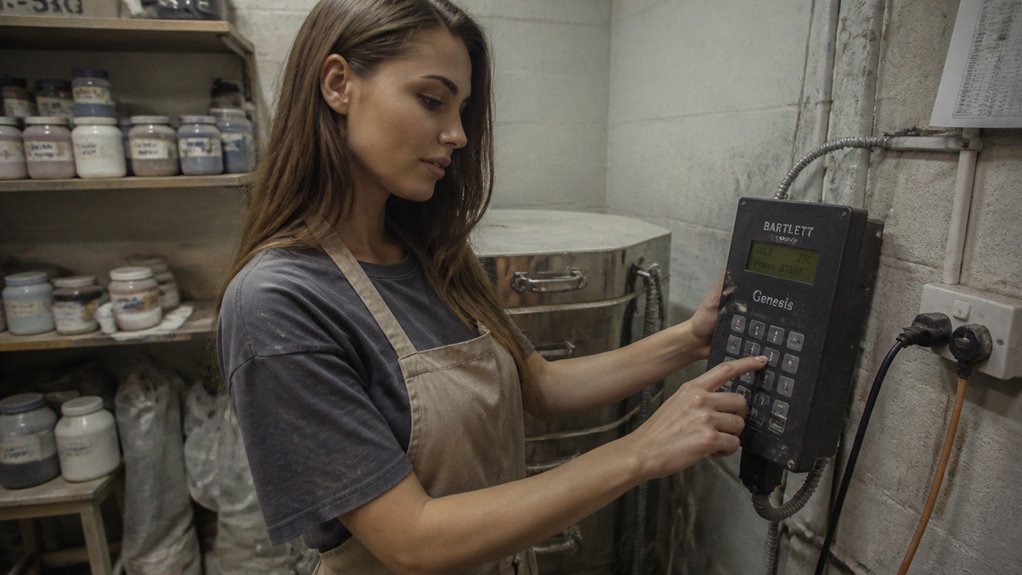
Digital controllers turned firing from a nervous guess into a repeatable science, and that shift is why they now dominate the market. Ramp programming lets you set exact heating rates per hour, so you are no longer babysitting switches.
Multi-segment schedules allow complex profiles like slow ramp, soak, and rapid cool, all automated and all repeatable. That precision enables techniques that were impossible before.
Glass annealing demands controlled cooling, and a manual kiln just cannot hold those gradients. Controllers store custom programs, so firing a familiar glaze batch takes one button press instead of a notebook of notes.
If you value consistency over nostalgia, digital wins. The learning curve is real, but the payoff is predictable pots and fewer cracked surprises.
Kiln Sitter vs Digital Controller: Key Differences
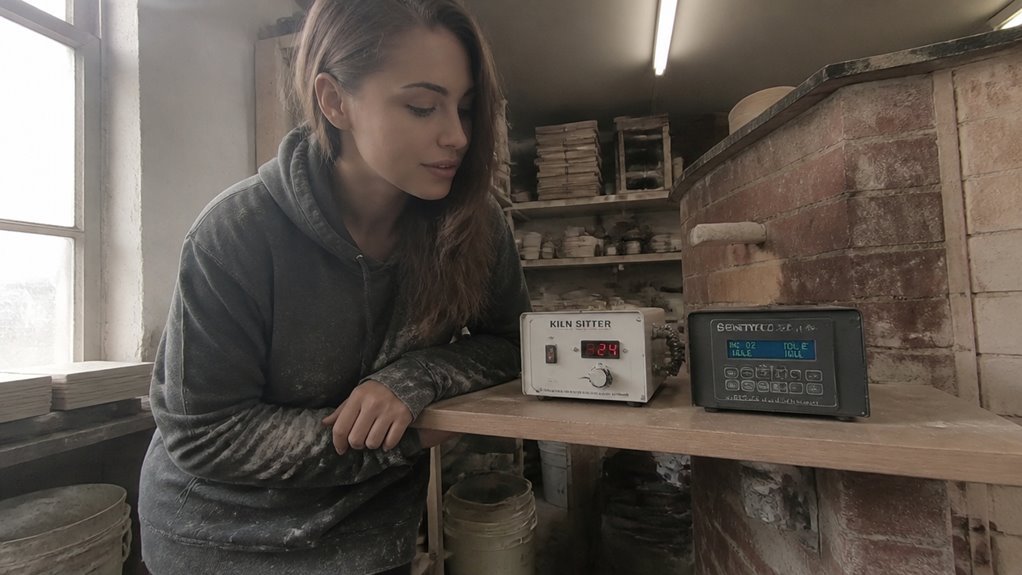
Choosing between a Kiln Sitter and a digital controller comes down to how you like to fire.
A Kiln Sitter uses a pyrometric cone that bends at a set temperature and trips a mechanical lever to cut power. It is simple, but you must adjust switches by hand during the ramp.
A digital controller cycles relays automatically and follows saved ramp and hold schedules. It delivers reliable, repeatable firings.
| Feature | Kiln Sitter | Digital Controller |
|---|---|---|
| Shut-off | Cone-based, mechanical | Temp-sensor exact |
| Ramping | Manual switches | Programmed segments |
| Accuracy | ±15°F | ±2°F |
| Monitoring | Visual cones | Digital display |
| Programs | None | Multiple presets |
If you enjoy tinkering with the firing process, the Kiln Sitter’s mechanical charm may suit you. If you prefer set-and-forget precision, the digital controller removes the guesswork.
Pick the tool that matches your workflow. Your kiln, your choice.
What Digital Controllers Cost vs. Control You Gain
A digital controller adds $100 to $300 to a new kiln’s price, but it stops you from babysitting switches or guessing ramp rates. You type in a schedule, and the controller fires the clay body precisely to cone, every time.
Expect a few confusing afternoons with the manual, and maybe a misfired batch or two. Everyone fumbles the first program; once you master it, repeatability becomes effortless.
If you fire more than a few times a month, the upfront cost buys real peace of mind. For occasional hobbyists, a simpler manual sitter still handles bisque and glaze firings fine.
Why Potters Choose Digital Controllers Today
A potter’s old kiln routine involved guesswork and a watchful eye. Digital controllers now deliver firing precision a kiln sitter cannot match.
The programming learning curve fades after one or two firings. It’s just menus, not math.
Your workflow becomes simpler: load the kiln, select a cone, walk away. That shift is the real game-changer.
| Feature | Digital Controller Benefit |
|---|---|
| Ramp Rates | Set exact heating and cooling speeds, every time |
| Holds | Soak at precise temps for glaze effects |
| Programs | Save recipes, repeat flawlessly later |
| Monitoring | Adjust remotely, catch issues early |
Custom schedules unlock artistic flexibility. You can experiment boldly with clay bodies and glazes.
Spend a bit more upfront for control that pays off in fewer failed loads and better results.
5 Situations Where a Kiln Sitter Still Works
The old mechanical kiln sitter still earns its keep in a few corners of the pottery world. It shines for budget‑conscious beginners who just want to fire a few mugs without spending an extra $200 on a controller.
For tiny test‑fire loads, the simpler shut‑off is plenty. If you are locked into a simple cone‑fire routine, the sitter’s one‑job simplicity is a comforting, low‑tech safety net.
It never needs a software update.
Budget-Conscious Beginners
Budget-conscious beginners are the one group where a kiln sitter still makes sense. When every dollar counts, a digital controller’s added cost can feel like a wall, not a feature.
A kiln sitter skips that premium entirely. You get a reliable, time-tested cutoff mechanism with no software, menus, or learning curve.
You will fiddle with switches to manage ramp rates. For simple bisque and low-fire glazes, that is manageable.
It is like driving a stick shift: clunkier, but cheaper and satisfying in its own way. You are paying for convenience you might not yet need.
If your wallet screams and your projects stay basic, the sitter keeps your first kiln affordable. You still get safety without the extra expense.
Small Test-Fire Loads
Small test loads still earn a kiln sitter its keep. A manual shut-off handles these firings well, because tiny loads rarely heat uniformly and a digital controller’s precise ramps can overcomplicate things. The sitter reacts to the actual kiln temperature instead of following a predictive algorithm.
You do not need to program anything for a one-off glaze test. Cone placement error stays negligible when the load is tiny. Repair costs stay lower if a test batch goes sideways, and the sitter’s mechanical simplicity tolerates frequent cycling. Setup is fast: drop in a cone and flip the switches.
For quick, low-stakes experiments, the sitter’s blunt simplicity beats digital fussiness every time.
Simple Cone-Fire Routines
A Kiln Sitter remains a perfectly fine tool for firing a few mugs to cone 6 without turning a pottery session into a lab experiment. It handles the only tricky part, shutting off at the right moment, by relying on cone bending to trigger the mechanical switch. You don’t need to program ramps or holds, just load the kiln, set the switch, and walk away. The trade-off is control, but for standard cone firings, it is negligible.
The Kiln Sitter routine is straightforward: set the switch high and wait for the cone to bend. The digital controller routine, by comparison, involves programming a ramp, soak, and cooling schedule. The sitter shows no temperature display, so you rely on witness cones to confirm the firing. The controller gives you real-time temperature readouts. With the sitter, you make manual switch adjustments; the controller cycles its relays automatically. The sitter works fine for cones 06 through 10, while the controller is best for complex schedules.
If your firing is predictable, the Kiln Sitter saves you money and fuss. Witness cones confirm success.
Are Digital Controllers Safer Than Kiln Sitters?
Digital controllers are safer than kiln sitters, but not for the reason most people guess. A kiln sitter shuts off the kiln reliably when the mechanical cone bends, yet it depends on you to set the right cone and check the firing, since it trips at one exact temperature.
A digital controller runs the whole firing sequence from start to finish. That removes most human error, but a relay or software glitch can still happen.
Neither system excuses walking away mid‑fire. Both need an external fail‑safe, like a high‑limit switch, to catch what the controller or sitter misses.
For any kiln wiring or safety upgrades, follow the manufacturer instructions or call a qualified electrician. Local codes apply.
Reliability of Shut-Off
A kiln sitter is a clever little contraption, but it is not a brain. Its shut-off depends on a cone bending at the right temperature, which is vulnerable to mechanical failure modes like a stuck lever or a warped cone shelf.
Thermal mass effects additionally matter. A heavy load can keep climbing after shut-off, overshooting your target.
Digital controllers, by contrast, use a thermocouple to read actual temperature and cut power electronically. They have far fewer moving parts to fail.
Shut-off is based on a physical cone, not a live temperature reading. Gravity levers can jam or misalign over time.
No feedback loop means no correction for thermal momentum. Relays are simple, solid-state switches with high reliability.
Digital units self-diagnose and alert you to faults. For dependable shut-off, digital wins hands down.
Operator Oversight Needs
Both setups still demand a human in the loop, but the kind of oversight shifts. A kiln sitter keeps you on your toes, babysitting switches and nudging dials through every firing. Firing supervision means watching a manual gauge and guessing ramp rates.
Digital controllers flip the script and handle the grunt work, but they aren’t a set-and-forget miracle. Relays can fail, so you still check the kiln during a run. The controller cuts manual stress, yet sloppy programming still bites back.
- Kiln sitter: hands-on, every firing.
- Digital: hands-off, but still eyes-on.
Digital is safer, but no kiln runs truly unattended. Buy the controller, keep an eye out, and you’ll get better results without the nail-biting.
Match Your Choice to Kiln Type and Monitoring Tolerance
Choosing between a kiln sitter and a digital controller comes down to two questions: what are you firing, and how much babysitting can you stomach? For small test kilns or beginner glass fusing units, a kiln sitter often suffices, since loads are tiny and schedules simple.
For larger ceramics or complex annealing cycles, a digital controller is worth the cash, despite its steeper learning curve and fiddly interface. Match controller complexity to kiln size: small kilns get a sitter, big kilns get digital.
Digital units cost $100–$300 more, but they save hours of manual switch fiddling. A kiln sitter only handles shut-off; you still control ramp speed by hand.
Digital costs more but saves hours of fiddling; a sitter just shuts off, leaving ramp control to you.
Digital allows delayed starts and multi-step holds, which suits glass or crystalline glazes. If you hate hovering over a pyrometer, go digital.
If you’re already stressed watching a cone pack, pony up the extra hundred bucks. Your sanity’s worth it.
Frequently Asked Questions
Can I Retrofit a Digital Controller Onto an Older Kiln Sitter Kiln?
Yes, you can retrofit a digital controller onto an older Kiln Sitter kiln, and it is a common upgrade for potters seeking precision. The mechanical sitter is removed, and a programmable unit takes over firing schedules, which greatly improves repeatability.
Before ordering parts, have an electrician check the kiln’s wiring and element resistance to ensure compatibility. Older kilns often need a new thermocouple and a high-limit safety switch, so budget for those potential upgrades.
One practical tip: label every wire and take photos before disconnecting the old sitter, as this will save you hours when wiring the new controller. This process works best on kilns with intact elements and sound brickwork.
In my experience, ease of installation varies widely by kiln model, so consult the controller’s manual and your kiln’s schematic. For firing schedules, always verify temperature limits with your clay or glaze manufacturer’s instructions before the first cycle.
Do Digital Controllers Work With Pyrometric Cones for Backup Shutoff?
Yes, digital controllers can work with pyrometric cones, but they usually do not provide backup shutoff with them. Most controllers rely only on thermocouples, which can fail and leave your ware overfired. A kiln sitter adds a physical safety net, but it complicates calibration and raises integration costs.
For a practical approach, keep a cone pack near a spy hole as a visual check, and manually note its bend before shutdown. Use a manual shutoff as your ultimate safeguard if the controller misbehaves.
Check your kiln manufacturer’s instructions for cone placement. Search for “kiln safety devices” to learn more. In my experience, pairing a thermocouple with a cone test is a wise habit, not a luxury. Your glaze results will thank you.
What Happens if Power Goes Out Mid-Firing With a Digital Controller?
If the power goes out mid-firing with a digital controller, the firing halts immediately and the controller loses its program state. Most controllers also clear their power failure data, so upon restoration you will need to manually restart the entire firing from the beginning.
Automatic cycle continuation is rarely built into standard digital controllers, so plan for a manual restart. To protect your work, write down the target temperature and ramp rate before starting, and keep the kiln closed until you can restart.
Check your controller’s manual for a “resume” feature, as some newer models offer it. Also, verify the power failure settings in your clay or glaze manufacturer’s instructions, since thermal shock can occur if cooling is too rapid.
Are Digital Controllers Harder to Repair Than Mechanical Kiln Sitters?
Digital controllers are indeed harder to repair than mechanical kiln sitters, but their built-in diagnostics make the job far more manageable than you might expect.
Start by checking the error code on the display, then consult your kiln’s manual to pinpoint the faulty thermocouple, relay, or wiring issue before opening the panel.
For a quick win, always test the thermocouple with a multimeter first, since it is the most common failure point and costs little to replace.
Mechanical sitters, by contrast, only need a visual check of the cone and the metal rod, though they lack the precise temperature control that digital units offer.
Search for “kiln controller troubleshooting” online if you need a step-by-step guide, and keep your owner’s manual accessible for wiring diagrams.
If you are ever unsure about a part, check the kiln manufacturer’s instructions for replacement specs, and never guess on voltage ratings.
In my experience, most digital repairs are simple swaps once you read the diagnostic code, so don’t fear the electronics.
The mechanical sitter remains a reliable fallback, but digital’s self-checks often save you time in the long run.
Can I Manually Override a Digital Controller During a Firing?
Yes, you can manually override a digital controller during a firing, though the available flexibility depends on your specific model. Most controllers let you adjust the ramp rate, hold time, or skip a segment mid-cycle, which is helpful when you spot a glaze issue.
However, the controller’s safety limits may block drastic changes, like jumping to a much higher temperature, to prevent kiln damage. Before you override, write down the current segment number and your original schedule, so you can return to it if needed. For precise adjustments, always check the clay or glaze manufacturer’s instructions for allowable ramp speeds. A useful tip: test a manual override on a low-fire bisque load first, so you understand the prompts without risking expensive ware. Related to this, “program hold” is a common feature you can practice with.
Rounding Up
Digital controllers win for most potters, but kiln sitters are not junk. They are just old tech, like a flip phone that still makes calls.
Check your budget and compare the $50–$150 sitter against the $300–$600 digital option. Write down whether you can babysit a firing, since the sitter needs you to watch cones bend.
Test your glaze melts: a sitter cannot fix a failure at 2 a.m., but a digital controller holds temps and auto-off. Ask yourself if you enjoy watching cones, because that is the real tradeoff.
Spend once and sleep more. Buy digital unless you truly love the babysitting.