
Finding a grogged clay that will hold up on large vessels without slumping or cracking is a constant battle at the wheel. You know the feeling of pulling up a tall wall, only to watch it wobble or distort as you work.
This guide cuts through the guesswork by comparing four top clays for big forms, focusing on their behavior with grog, shrinkage, and firing ranges. We will look at how each clay’s specific traits, from coarse texture to plasticity, affect your throwing and finishing process.
Before you choose your next bag, consider the key factors of moisture and grog percentage that can make or break a large piece.
Quick Answer
- Choose AMACO High Fire Stoneware for tall vases and large bowls because coarse grog prevents slump.
- Use Seattle Pottery Vashon White for large pieces, but plan for 11.5% shrinkage in advance.
- Apply SIO-2 PRNI Black to reduce warping, though cost and tackiness limit it to special projects.
- Select SIO-2 PRAI White for high plasticity, but fine grog and 12.9% shrinkage challenge large forms.
- Prioritize 15-20% coarse grog and under 12% total shrinkage for flawless large vessels.
| Seattle Pottery Vashon White Stoneware Clay 25 lbs |  | Best Overall | Grog Content: Added grog for stability | Firing Range: Cone 4–6 | Weight: 25 lbs | SEARCH BEST PRICE | Read Our Analysis |
| SIO-2 PRAI White Stoneware Pottery Clay 27.6 lb |  | Professional Grade | Grog Content: High grog content (80 mesh) | Firing Range: Cone 6–10 | Weight: 27.6 lb | SEARCH BEST PRICE | Read Our Analysis |
| AMACO High Fire Stoneware Clay with Grog 50lb |  | Best Value | Grog Content: Contains grog | Firing Range: High fire (cone 6+) | Weight: 50 lb | SEARCH BEST PRICE | Read Our Analysis |
| SIO-2 PRNI Black Stoneware Clay for Pottery |  | Best for Sculpture | Grog Content: High grog content (80 mesh) | Firing Range: Cone 5–6 | Weight: 27.6 lb | SEARCH BEST PRICE | Read Our Analysis |
More Details on Our Top Picks
Seattle Pottery Vashon White Stoneware Clay 25 lbs
Vashon White suits home potters who want a reliable clay body for large vessel work without fighting the wheel. It is best for beginners and intermediate makers who need a forgiving material for handbuilding, pressing, or throwing tall forms. This creamy stoneware from Seattle Pottery throws easily, and the grog, tiny fired clay bits, prevents cracking and sagging in big pieces.
It fires to cone 4-6, which matches most standard studio kilns. The main strength is its tolerance for uneven technique, so you can focus on form instead of worrying about collapse. One honest drawback is the 11.5% shrinkage at cone 5, so you must plan your final size carefully or your piece will come out smaller than expected. Oxidation fires to an off-white surface, which works well with mid-range glazes.
Compared to other clays in this lineup, Vashon White has a coarser texture because of the grog, so it is not your choice for delicate, smooth surfaces. It differs from porcelain or fine white bodies by offering more structural support for wider bases and heavier walls. Seattle Pottery has shipped kilns and glazes worldwide since 1975, so their clay body consistency is trusted in many home studios.
Use it on the wheel for a vase or a planter, or press it into a mold for a bowl. A 25-pound bag gives you enough material to practice several throws in one session. When you trim or attach handles, the grog holds edges well, reducing slumping. Keep your wheel speed moderate, and let the clay dry slowly under plastic to avoid stress cracks at the seams.
- Grog Content:Added grog for stability
- Firing Range:Cone 4–6
- Weight:25 lbs
- Color:Creamy white
- Application:Handbuilding, sculpture, pressing
- Brand:Seattle Pottery Supply
- Additional Feature:In business since 1975
- Additional Feature:11.5% average shrinkage
- Additional Feature:Fun for all skill levels
SIO-2 PRAI White Stoneware Pottery Clay 27.6 lb
SIO-2 PRAI suits potters who throw large forms and want a reliable, forgiving clay body straight from the bag. This professional-grade Spanish import comes from Activa, a world leader in natural clay, and fires to an intense white between Cone 6 and 10.
Its high plasticity rating of 16 gives it a soft, silky feel that handles well on the wheel, while the fine 80-mesh grog adds strength without irritating your hands. That impalpable sand content also prevents cracking during drying, which makes it a strong choice for tall vases or sculptural pieces.
One honest limitation is the 12.9% total shrinkage, so you must size up your measurements to avoid smaller final pieces than expected. This clay differs from denser, darker stonewares in its pure white finish, which makes glazes look vivid and detailed, especially with dramatic oxide washes.
For a home studio, it comes ready to use at 27.6 lbs, and it performs flawlessly when you need even drying on large vessels. If you are comparing clay bodies, this one stands out for high-detail work where a clean, bright surface matters more than a rugged, earthy texture.
Keep in mind that its smoothness means it may not suit beginners who prefer more tooth for control, but experienced throwers will appreciate how it holds shape without tearing. On the kiln side, fire it in a well-ventilated area and follow standard bisque and glaze schedules for Cone 6 to 10.
Use it when you want a clay that lets the form speak, not the body itself, and it will reward you with crisp edges and a glassy glaze response. For wheel work, its plasticity reduces the need for constant re-centering, saving you time on large batches.
If you also work with lower-fire clays, note that this body needs higher temperatures, so plan your kiln loads accordingly. The trade-off is a more durable, vitrified result that holds up in functional sculpture, though you should never assume food safety without a proper glaze fit test.
This is your go-to for sculptural, dramatic work where precision and a clean white base are non-negotiable, and it clearly outshines coarser clays in surface detail. When you order, expect a dense, ready-to-wedge block that requires minimal preparation, just a quick knead before throwing.
- Grog Content:High grog content (80 mesh)
- Firing Range:Cone 6–10
- Weight:27.6 lb
- Color:White
- Application:Wheel throwing, hand building, modelling
- Brand:Activa
- Additional Feature:Imported from Spain
- Additional Feature:Soft silky feel
- Additional Feature:Fires to cone 10
AMACO High Fire Stoneware Clay with Grog 50lb
Anyone serious about throwing big pots knows the struggle is real. You need clay that won’t collapse mid-throw, and AMACO’s buff stoneware, 50 pounds, delivers.
It is non-toxic, damp, and ready straight from the bag. The grogged body gives grip and structure without sacrificing wheel smoothness.
This clay is best for a home studio potter who throws tall vases or large bowls and fires to cone 6 or 10. Its clear strength is the high-fire range, which lets you match it to most studio kilns.
The honest drawback is the coarse texture; it can be rough on your hands during long wedging sessions. Unlike smoother porcelain or a fine white stoneware, this body keeps its shape when you pull up thick walls.
The speckled buff finish (No. 48) looks great bare, so you can skip glaze on the outside. Bulk sizing means you can throw multiple large vessels from one bag without reordering.
You will find it forgiving yet firm on the wheel, so it suits beginners learning to center larger amounts. A more experienced thrower will appreciate that it does not slump when you add a tall neck or rim.
It is listed as a toy, but wrestling 50 pounds of clay is no game. Grab this workhorse for big pots when you need reliable structure from the first pull to the last trim.
- Grog Content:Contains grog
- Firing Range:High fire (cone 6+)
- Weight:50 lb
- Color:Buff
- Application:Hand-building or wheel-throwing, sculpting
- Brand:AMACO
- Additional Feature:Non-toxic safety
- Additional Feature:Speckled buff texture
- Additional Feature:Industrial-grade container
SIO-2 PRNI Black Stoneware Clay for Pottery
Sculptors chasing fine detail on hefty forms need this clay. SIO-2 PRNI, a Spanish import, pairs high plasticity with a soft, silky touch that makes it a joy on the wheel. That 80-mesh grog includes fine pre-fired particles that reduce warping during drying and firing, so large hand-built vessels stay true to shape.
It fires to graphite black at Cone 5-6, and shrinkage holds around 7% both ways. The dark body makes glazes pop like fireworks, and the surface stays vitreous and durable after bisque. It is ISO-certified and glaze-friendly, so you can trust it in a shared studio.
This clay is best for detail-obsessed artists who want crisp edges without fighting the material. Its one honest drawback is the cost: at 27.6 pounds, it sits heavier on the wallet than the studio’s other stonewares, so it suits special projects rather than everyday throwing.
Compared to the smoother white stoneware in this lineup, SIO-2 PRNI offers more tooth for sculpting and a darker finish, but it needs a bit more water when centering. If you mostly throw mugs and bowls, the high plasticity might feel tacky at first, yet hand builders will appreciate the grip.
Keep your kiln vent running during the final firing, since the grog content can release a bit more gas than a fine-grained clay. For home studio potters who glaze at Cone 6, this body holds its black color without bloating, as long as you fire it slowly through quartz inversion. Use it for relief tiles or carved planters where you want the unglazed surface to stand out.
- Grog Content:High grog content (80 mesh)
- Firing Range:Cone 5–6
- Weight:27.6 lb
- Color:Black
- Application:Wheel throwing, hand building, modelling
- Brand:Activa
- Additional Feature:ISO 6486 food safety
- Additional Feature:Deep graphite black finish
- Additional Feature:21% water content
Factors to Consider When Choosing Grogged Clays for Large Vessels
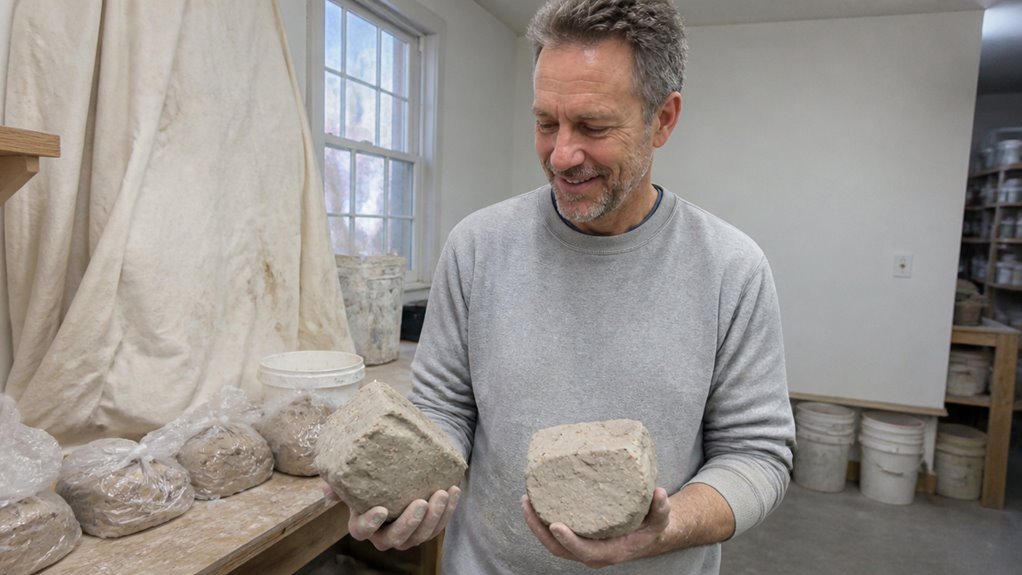
Five factors matter when you choose a grogged clay for large vessels: grog content ratio, plasticity, firing range, shrinkage control, and dampness consistency. Pick these wrong and you get a cracked masterpiece and a sad kiln shelf.
The right grog percentage gives clay structural teeth to resist slumping under its own weight. Too much grog turns the clay gritty and low in plasticity, so coil joins won’t hold.
Aim for 20–30% grog for big forms. A clay like SIO-2 PRNI Black Stoneware balances strength and workability at about $55 per 50-pound box.
Firing temperature and shrinkage go together. Choose a clay that matures between 1200–1300°C with under 12% shrinkage.
Always test a small slab for dampness consistency before throwing a massive pot. Dry spots are your sneakiest enemy, so wedging thoroughly and keeping the clay evenly moist helps.
Grog Content Ratio
For any vessel over 12 inches tall, use at least 10% grog by volume. That is the baseline for managing uneven drying stress.
For serious stability in thick walls, aim for 15-20% grog. Higher ratios reduce wet-to-dry shrinkage, which means less cracking.
Coarse grog, in the 20-40 mesh range, works better than fine 80-mesh for preventing slump. The larger particles lock a tall form together.
Use 10% grog as the minimum for anything over a foot tall. Use 15-20% for thick-walled, heavy forms.
Choose coarse mesh to resist distortion during drying and firing. You will adjust your throwing technique, and that is a normal part of the process.
My first tall vase slumped like a tired soufflé, so I learned this the hard way. Do not skimp on grog; your vessel’s structural integrity depends on it.
Plasticity and Workability
A grogged clay’s real test is its plasticity, not just the grog. Aim for a measured plasticity index around 16, meaning the clay stretches and compresses without cracking, which is essential for tall walls.
A soft, silky feel with high water content, say 19-21%, makes centering a breeze. You can pull up heavy forms without fatiguing your forearms.
Fine 80-mesh grog reduces stickiness and helps the clay hold its shape. Think of grog particles as internal scaffolding that keeps everything rigid during stress, so you avoid slumping or tears.
Balance your shrinkages: drying around 5.9-7.0%, firing at 7.0-7.1%. This keeps the clay pliable without warping.
Pick a clay that bends but doesn’t break, or you will fight it all day. The effort is worth it.
Firing Temperature Range
Match the clay body to your kiln’s firing range, and your planter will hold its shape. Low-fire grog matures at cone 06–04 (1830–1940°F) and stays porous and weak, so it leaks and cracks under weight. Use it only for small trinkets, not large vessels.
Mid-range stoneware, cone 4–6, shrinks 5.9–11.5% depending on the body and gives a decent balance of workability and strength. High-fire stoneware, cone 6–10, vitrifies denser and offers the mechanical strength needed for tall, wide forms without slumping.
Follow the manufacturer’s cone rating exactly. Under-firing the body causes weakness, bloating, and warping. Over-firing turns your planter into a puddle.
For large vessels, choose a high-fire body and fire to spec. Your planter will stand tall instead of collapsing into a ceramic pancake.
Shrinkage Control Measures
Shrinkage can steal size from your planter if you do not plan for it first.
A body with drying shrinkage around 5.9% cuts warping risk as water exits, compared to 7.0%.
Firing shrinkage needs to be factored into your dimensions before you build, or the finished pot will be smaller than expected.
Choose a cone 5–6 clay (2205–2269°F) because it shrinks less than high-fire bodies.
Total shrinkage can exceed 12–14%, so calculate drying plus firing shrinkage before you start.
Grog helps control contraction.
80 mesh grog acts like a rigid skeleton inside the clay matrix, limiting how much the piece shrinks.
Pick a grogged clay with a moderate firing range, low drying shrinkage, and fine grog.
You will fire a pot that matches your planned size, and your kiln shelf stays safe.
Moisture Consistency Levels
Clay moisture should sit around 19 to 21 percent water. This keeps walls stiff enough to hold their shape without sagging.
Above 21 percent, you risk warping or a total collapse mid-throw. Below 19 percent, drying shrinkage drops, which spares rims from cracks.
Even hydration matters more than the exact number. A grogged clay with wet spots dries unevenly and forms stress fractures you didn’t plan for.
For larger vessels, aim for 18 to 20 percent moisture. This drier, stiffer mix holds firm during long throwing sessions.
Pick the drier 18 to 20 percent range for big pieces. Your vessel will stand strong, and your back will thank you.
Structural Integrity Support
Grog is prefired, ground clay that acts like a skeleton inside your clay body. It forms a mechanical mesh that holds tall walls upright, which makes it the real difference-maker when you’re throwing big.
The angular particles interlock with the clay matrix, spreading stress evenly and blocking crack growth during drying and firing. You lose a little plasticity, but you gain serious green strength so wet clay won’t collapse on you.
Shrinkage drops to around 5.9%, so warping stays minimal. For cone 4-6 firings, grog also cuts thermal shock risk, protecting your piece through quartz inversion.
Key benefits: less sagging, fewer cracks, less warping. For large vessels, grab a high-grog body.
Use 80-mesh grog for best results. It’s your insurance policy.

Shape and smooth large walls with flexible ribs that follow curves without tearing.

Lift finished vessels safely with bats that prevent warping and ease removal.

Slice clean blocks from your clay bag for consistent wedging and less waste.
See today's best deals onPottery Tools
Frequently Asked Questions
How Do I Prevent Cracking During the Drying Phase?
To prevent cracking during the drying phase, cover your vessel loosely and rotate it daily to ensure even moisture loss. This simple routine stops stress from building up in the clay, which is the main cause of surface fractures.
For thicker walls, patience is essential. Allow at least several weeks for dampness to leave very slowly, and never rush the process with heat or fans. A gentle, steady air flow around the piece works best.
One concrete tip: place a damp cloth over the rim if the top dries faster than the base. This evens out shrinkage and reduces the risk of splits. If you notice any hairline cracks early, you can smooth them with a wet finger before they deepen. For any health concerns about your pet using the finished piece, check with your vet.
Can These Clays Be Used for Raku Firing?
Yes, these clays can be used for raku firing, but you must test a small piece first to confirm they can handle the thermal shock. The grog content helps reduce cracking, but it is not a guarantee for every vessel.
Use a coarse clay body with at least 20% grog for the best results, and fire your test piece to the same temperature you plan to use.
Before committing a full piece, check the clay bag for a recommended raku range, typically above cone 06. If you see any hairline cracks after quenching, switch to a clay labeled specifically for raku or add more grog to your mix.
For a practical tip, preheat your kiln to 1800°F and ramp quickly, but keep a metal trash can with sand nearby to bury the piece for cooling.
If you are unsure about your clay’s suitability, a “thermal shock test” can save you from losing a finished pot, so always run it first.
What Kiln Ramp Schedule Works Best for Tall Forms?
The best kiln ramp schedule for tall forms is a slow bisque firing at 100°F per hour up to 1800°F, followed by a glaze firing at 150°F per hour with a 15 minute hold at peak temperature. This gradual pace prevents thermal shock, which is the main culprit behind cracking at the base of tall pieces.
Go even slower through the quartz inversion zone around 1060°F, as this is where silica expands suddenly and can stress your form. For your pet’s ceramic water fountain or bowl, patience here means fewer ruined pieces and less frustration.
A concrete tip is to add a 20 minute soak at 1600°F during the bisque ramp to even out heat distribution. Never rush a firing, especially for tall forms, because the base and rim heat at different rates.
If you see any warping or cracks after firing, adjust your ramp down by 25°F per hour next time. For health concerns related to glazes or materials, always check with a vet before using the piece around your pet.
Should I Wedge Grogged Clay Before Throwing Large Pieces?
Yes, you should always wedge grogged clay before throwing large pieces, because it directly lowers the risk of structural failure.
This step removes air pockets that hide inside the grog particles. Those pockets are the main cause of cracks when your tall walls dry. Spend two to three extra minutes kneading the clay on a plaster bat, working from the outside toward the center.
You will notice fewer pinholes on the surface after bisque firing. A well-wedged lump also throws more evenly, which saves you from sudden wall collapses. Think of each fold as a small insurance policy for your piece.
For best results, wedge in two directions, then test for soft spots by pressing a thumb into the center. If the clay resists evenly, you are ready to center. If it feels spongy, keep folding.
For health concerns about clay dust or your hands, check with a vet only if your pet chews the clay. Otherwise, keep your work area damp and clean.
How Does Grog Size Affect Surface Texture After Firing?
Grog size directly affects surface texture after firing, with coarser grog creating a rugged, pitted, almost rocky finish and finer grog leaving a smoother, more refined surface.
For a practical tip, test both grits on small tiles before your main piece, then choose based on your desired aesthetic, as both options fire flawlessly.
Your pet’s comfort matters, so if you sculpt a toilet area, opt for finer grog to avoid scratchy spots that could irritate paws during cleanup.
Alternatively, coarser grog adds durable grip for outdoor litter zones, which can help prevent sliding on wet surfaces.
Remember that grog’s particle size also influences clay shrinkage, so adjust your drying time accordingly.
For health concerns about your pet’s skin or paws, always check with a vet before changing textures.
Rounding Up
For large vessels, the grog you choose is the main question, and the SIO-2 PRAI White answers it best at $27.60 for 27.6 lbs.
Test it against your tall throwing and fire it to cone 6, checking for warping or cracks.
Compare its gritty bits to the smoother Vashon White, which costs more per pound, and the AMACO High Fire for massive sculptures.
Write down how each one holds when things get wobbly, like a steady anchor.
Keep the PRAI as your go to, since it is priced and proven for flawless results.
Trust that grog is about stability, not smoothness, so choose the one that keeps your pots standing proud.